
Richard T
20 years together, 7 years after

We each had been married before. And this marriage was so much happier for both of us.
Ewa [pronounced “Eva”] was the most amazing person that I have ever met. She was raised in communist Poland as an atheist, but she was very spiritual. When she went to university, she gravitated to Catholicism, because that was really the only choice there was in Poland. Later, while living in the States, a friend took her to a synagogue and that was it. She converted to Judaism. It was before she even met me. And then she ended up with a career in Jewish education. She got two master’s degrees, and she had another master’s degree in linguistics, from Poland.
Ewa proposed that we move to New York, and I was thrilled, having lived there before we met. She was able to get a decent job with a Jewish nonprofit. The year we moved back to New York was probably one of the happiest years of my life. I remember walking down the street, just being so grateful to be here.
We were living in Poland when she died, because her mom was there, and her dad had passed away. She had horrible memories of growing up in a dysfunctional family, in a communist country. Being back in Poland seemed to bring all her demons out, you know? Plus, she’d had a bad experience in New York. She lost her job and I think she wanted to get away from that.
I think because of her past and upbringing and her genes, she struggled with her mental health, issues with depression and anxiety. But I never knew the degree to which she was struggling.
The last time I returned to Poland from visiting New York, which was maybe a couple of months before she died, she said, ‘oh my gosh, I’m so glad you’re back, you have no idea where my mind went while you were gone’. And I didn’t really press her on it. But it was about six weeks or seven weeks after that when she died by suicide.
A good friend of Ewa’s had called around to the police and hospitals, as Ewa’s mother and I hadn’t a clue where she was. She wasn’t home, or at her mother’s where she told me she’d be the previous night. Eva told me that she was going to accompany her mother to the doctor early in the morning.
As soon as we got to the hospital, they ushered us into this little waiting room where a doctor came in. I’m going to tear up here. The doctor said, ‘I’m sorry, but your wife passed away about 30 minutes ago. We did everything. We couldn’t save her’.
And I still didn’t know what happened, you know? I just had no idea what had happened. And I said, ‘was there an accident’? And she said, ‘no’. And then the doctor handed me this short suicide note, she put the note in my hand.
God, the note was disappointing. That’s one thing I’m still mad at her about.
It gave my phone number. My husband’s number is...he does not speak Polish.
And then it just said something about being completely exhausted, you know, nothing left to give, keep on loving each other, you know, something like that. Then they let me into the room where she was, and I was able to hold her.
I think I walked home from the hospital. I remember feeling that my life was ruined.
There were three different memorial services for Ewa. There was one in Krakow, which was lovely. And there was one in New York. And there was one in Cleveland, where we’d first met. So, I had a lot of support. But still, I don’t know, it’s like you just don’t get over it.
I think I was really determined to make the most of what I had and not be mired in grief. All the things that I had to compromise on in my marriage to Ewa, I was going to take advantage of now. One thing was moving back to New York. And then I wanted to rent a studio. I also think I started dating too soon. I think that was also a way to not deal with the grief. And it ended up catching up with me.
The events of October 7th, and the thing with Hamas and Israel, and Gaza, triggered what they call an episode of hypomania. You’re still in touch with reality, but you have this kind of unbelievable amount of energy and drive. And lack of judgment.
So suddenly I learned that I’m bipolar. After my period of hypomania, I ended up in this horrible depression. And it was ruining my life. One of my doctors suggested that my depression was a grief reaction.
I remember I had this dream not long after she died, that we were driving around Krakow. I remember thinking that I know that she’s dead, but I don’t want to tell her that she’s died because she might get upset. She just said, ‘I miss you’.
I miss her spontaneous shows of affection. We had different tastes in music and things like that. But we shared a sense of humor. She was really a scholar. That was her at heart. But her favorite movie was Animal House!
I think about her a lot at high holiday services and reading through the prayer book, and especially the commentaries.
I find music, art, painting, and photography helpful. I find therapy helpful.
My art has always been kind of grief oriented. I’ve always been a melancholy person. The project that I’m working on now is triggered by Ewa’s death, so it’s really about love and death, and how they’re kind of related- two sides of the same coin. The title is “The Great Reconciliation”.
My advice for others having lost a spouse would be to try to connect with other people that are going through the same thing. I think that is, for me, probably the most helpful feeling, so that you don’t feel alone.
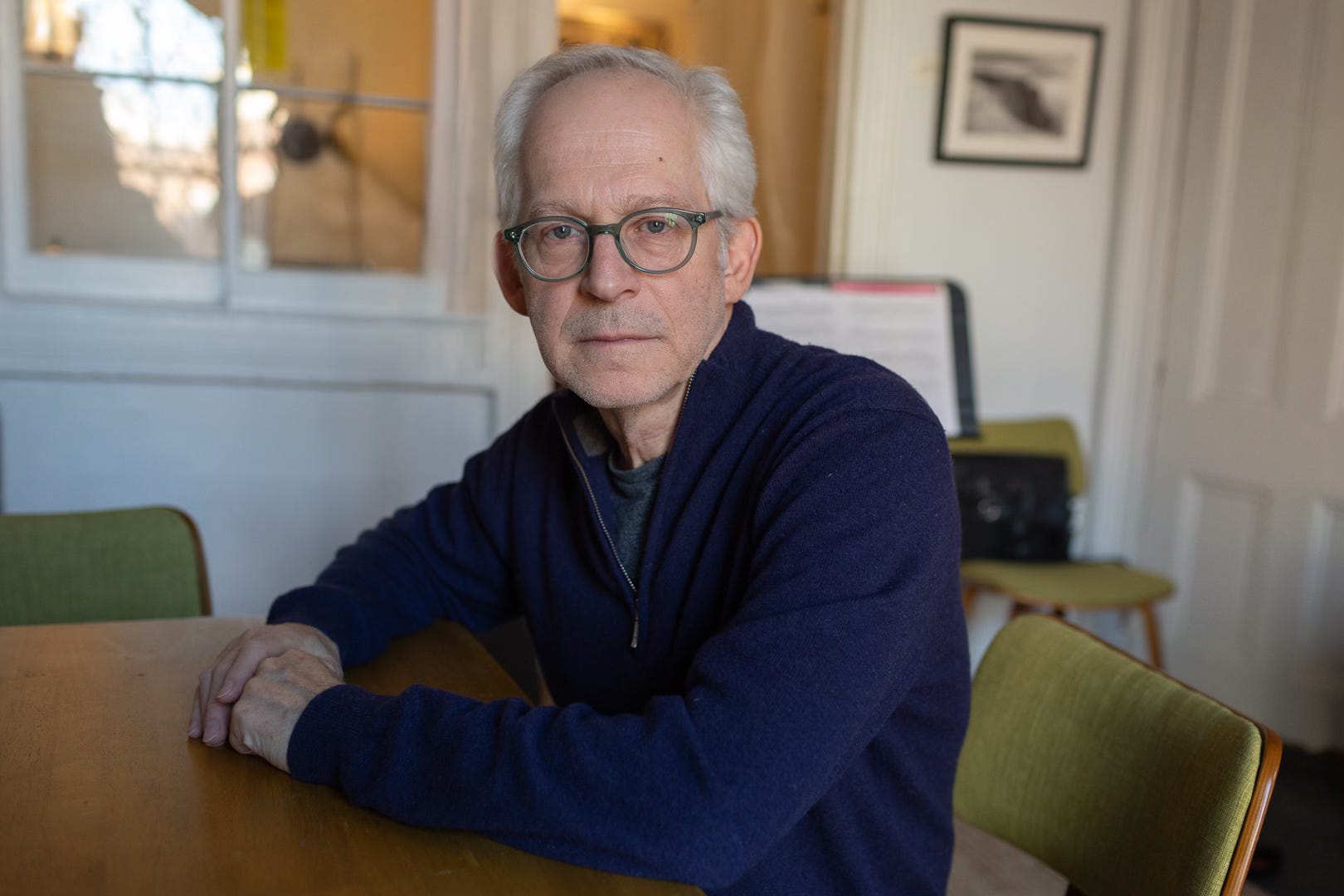
I have read this through twice. Richard's portrait is another perfect pairing of image + narrative. The stare that holds so much of my own curiosity followed by the narration of loss from suicide was so profound, I didn't realize I was holding my breath. Another stunning photograph in this most important project.